

Our Rooms
From First Discoveries to Big Ideas
Three stages. One thoughtful journey.
From a baby's first explorations to a preschooler's increasingly complex questions, our approach grows alongside each child. The environment, experiences, expectations and role of the practitioner naturally change as children develop. Across every room, our practice remains rooted in the EYFS and influenced by Montessori, Steiner, Forest School, Piaget, Vygotsky and Bandura. What that looks like, however, is wonderfully different at every age.
🌱 The Discoverers | Babies & Young Toddlers | 0–2
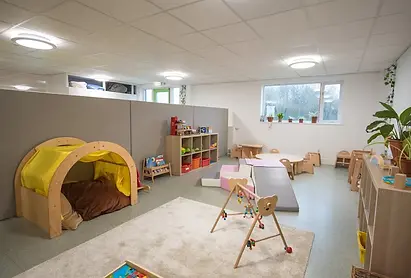
For our youngest children, learning begins with relationships. Warm, responsive practitioners create the security children need to begin exploring their environment confidently. We respect individual sleep, feeding and care routines while gradually introducing the familiar rhythms of nursery life. The environment is calm, inviting and carefully considered, with opportunities to move, touch, listen, investigate and communicate.
A typical day might include treasure baskets and heuristic play, sensory exploration, music and movement, stories, messy play, garden experiences, natural materials and plenty of opportunities for floor-based physical exploration. As children become ready, practitioners encourage small steps towards independence — choosing between resources, feeding themselves, finding their belongings or helping with simple everyday routines. There is also time for cuddles, quiet moments and rest. Babies don't need to be constantly entertained. They need secure relationships and the freedom to explore at their own pace.
🌿 The Explorers | Toddlers | Approximately 2–3
Our Explorers are developing language, independence, friendships and increasingly strong ideas about what they want to investigate.Their days provide plenty of opportunities to move, experiment, make choices and get wonderfully involved in their learning.
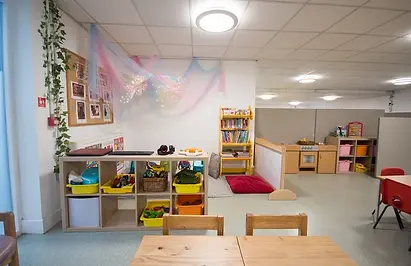
Children might begin the morning choosing their own play before coming together for a short story, song or conversation. Throughout the day they may be mixing and pouring in a sensory investigation, creating large-scale artwork, building with loose parts, preparing their own snack, dancing to music, gardening, investigating insects, visiting the local park or experimenting with water, sand and natural materials. Practitioners introduce new vocabulary, model social interactions and extend children's thinking through conversation.
🌳 The Pioneers | Preschool | Approximately 3–5 Years
By preschool, children's questions become bigger. Why does ice disappear? How does a seed know when to grow? Can we build a bridge strong enough to stand on? Where does rain come from?We want to protect that curiosity. Our preschool environment encourages children to become increasingly confident thinkers who can develop ideas, test possibilities, communicate their thinking and work alongside others.
Children have access to carefully selected opportunities across early mathematics, literacy, science, construction, art, storytelling, imaginative play, music, physical development and the natural world. But learning doesn't need to look like school. A cooking experience can involve mathematics, science, language and cooperation. Building a den can involve engineering, negotiation, physical development and problem-solving. A woodland walk can become an investigation into seasons, habitats, patterns, numbers and the changing natural world. Practitioners introduce increasingly challenging questions and vocabulary while knowing when to become involved — and when to allow children to lead their own investigation. Children are encouraged to take responsibility for their environment, make choices, manage belongings, develop self-care skills and contribute to their nursery community. These are foundations not only for Reception, but for learning throughout life.

Get in Touch
This is a Paragraph. Click on "Edit Text" or double click on the text box to start editing the content.